
A theory of universal architectures for and by control
Complex layered control architectures increasingly automate all aspects of our lives, including scientific experiments thru data analysis and reporting. Most of this is by evolution and not enough intelligent design, so spectacular innovations often hide dangerous fragilities. This talk will sketch what theory has been successful in control in aerospace, process, power, internet, medicine, biology, wildfires, earthquakes, LIGO, and CERN, and why the latest developments (cryptically named SLS, LAO, ULA, DeSS, DLMPC, FBC, etc) are particularly promising, and will be more essential with widespread use of AI.
We'll briefly describe why attempts to bring even minimal rigor to the "new sciences" of emergence, complexity, and networks failed, and how we might avoid this in the future.
Finally, we'll speculate about how a rigorous theory of experimental control infrastructure could help resolve confusing foundational issues that physics has in explaining real experiments with theory.
Prof. John Doyle
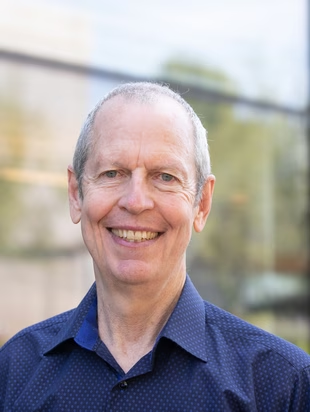
John Doyle, Caltech (1985-) is the Chameau Prof Emeritus of Control and Dynamical Systems, and BioEngineering. BS, MS MIT 1977, Consultant to Honeywell SRC 1976-1991, PhD Math, Berkeley, 1984. Theoretical foundations for complex bio, tech, and social architectures that have evolved from bacteria. Best known for great collaborators and students. Held world records and championships in various sports.