ICALEPCS 2025 Advanced Control Workshop

America/Chicago
Palmer House Hilton Chicago

Palmer House Hilton Chicago

17 East Monroe Street Chicago, IL 60603, United States of America
Daniel Tavares (CNPEM)
Description

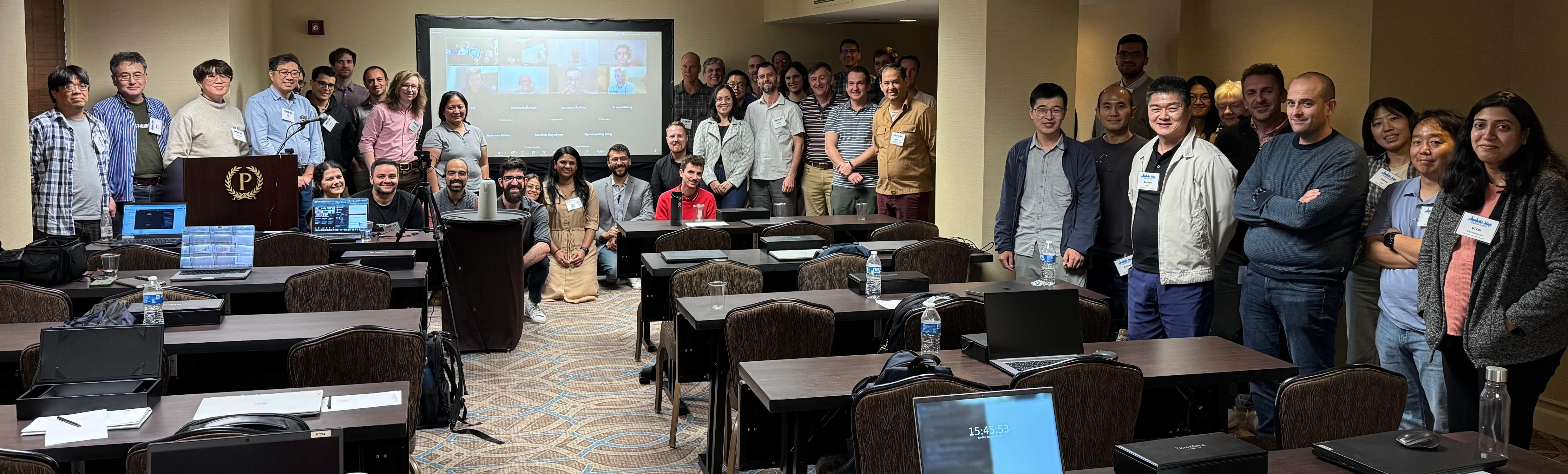
The ICALEPCS 2025 Advanced Control Workshop gathered experts and beginners interested in sharing experiences and ideas on the application of control theory to real world feedback and feedforward systems, focusing on the optimization and stabilization of control loops (at design time or real time), applied system identification techniques, design of control architectures, autonomous decision systems, digital signal processing and hardware platforms where advanced control algorithms are implemented.

The talks recordings are now available at the ICALEPCS YouTube Channel.

The talks slides can be found in the Timetable page.

Feedback control systems are ubiquitous in large experimental physics facilities, from simple Proportional-Integral loops to layered control loops with multiple inputs and outputs, different sampling rates, high-order controllers, non-linear or time-varying plant responses, for which optimized performance is achieved based on system dynamics modeling. Many of such systems can operate fairly well with low tuning efforts, however a few others can largely benefit from a thorough system optimization rooted in control theory to provide relevant performance and robustness gains for the entire scientific facility.

In the ICALEPCS community, closed orbit or trajectory feedback systems, multibunch feedback systems, LLRF, fast power supplies, high performance timing systems, nanopositioning and other high dynamic mechatronic systems, plasma control, adaptive optics and radio telescope antenna control are the kind of systems typically requiring such advanced control techniques, but the list of applications may go far beyond due to the universality of the control techniques. System modeling, system identification, plant optimization, controller tuning, loop shaping,  robust control, adaptive control, nonlinear control, Model Predictive Control (MPC) and Iterative Learning Control (ILC) are only a few examples of such techniques.


    • 1
      Advanced Control Workshop Introduction
      Speaker: Daniel Tavares (CNPEM)
    • 2
      [REMOTE TALK] A Theory of Universal Architectures for and by Control

      Complex layered control architectures increasingly automate all aspects of our lives, including scientific experiments thru data analysis and reporting.  Most of this is by evolution and not enough intelligent design, so spectacular innovations often hide dangerous fragilities.  This talk will sketch what theory has been successful in control in aerospace, process, power, internet, medicine, biology, wildfires, earthquakes, LIGO, and CERN, and why the latest developments (cryptically named SLS, LAO, ULA, DeSS, DLMPC, FBC, etc) are particularly promising, and will be more essential with widespread use of AI.  We’ll briefly describe why attempts to bring even minimal rigor to the “new sciences” of emergence, complexity, and networks failed, and how we might avoid this in the future.  Finally, we’ll speculate about how a rigorous theory of experimental control infrastructure could help resolve confusing foundational issues that physics has in explaining real experiments with theory.

      Speaker: Prof. John Doyle (Caltech)
    • 3:30 PM
      Break
    • 3
      System Decoupling and Control for High-Dimensional, High-Throughput Orbit Feedback

      This talk explores recent advances in system decoupling techniques for control of strongly directional multi-input systems, focusing on the transformation from coupled MIMO dynamics into single-output, multi-input structures. We begin by motivating the need for decoupling through the lens of gain separation, highlighting the challenges posed by actuator constraints and model uncertainty in low-gain directions. We then introduce a hierarchy of decomposition tools—ranging from standard SVD (single-array) to GSVD (two-array, currently used at Diamond-II), and ongoing work extending to multi-array decompositions. Once decoupled, the system becomes amenable to a wide range of SISO-based design tools including feedforward compensation and loop shaping. We emphasize the critical role of orthonormal transformations in achieving reliable decoupling, and briefly discuss strategies when exact orthogonality is not feasible.

      Speaker: Hyuntae Kim (Univ. of Oxford)
    • 4
      Advances in Orbit Feedback Control for Enhancing Beam Stability at Advanced Photon Source

      A fast orbit feedback (FOFB) system is being developed for the upgraded Advanced Photon Source (APS) where beam sizes of 13 µm horizontally and 2.8 µm vertically with a target unity-gain bandwidth of 1 kHz. The system uses a distributed network of 20 feedback controllers to compute orbit corrections at 22 kHz, utilizing 560 Beam Position Monitors (BPMs), 160 fast correctors, and 160 slow correctors per plane. A Bunch Lengthening System (BLS) has been installed at APS to enhance beam lifetime, with the synchrotron tune ranging between 100 and 650 Hz, overlapping the FOFB closed-loop bandwidth.

      Building on the FOFB framework, we developed a feedback algorithm that uses horizontal beam position measurements at dispersive BPMs as input and the low-level RF (LLRF) phase as an actuator. Experimental results and simulations demonstrate that this approach effectively corrects synchrotron frequency oscillations while operating concurrently with orbit feedback to damp betatron oscillations. To unify the operation of fast and slow correctors in a single algorithm, we implemented two methodologies: (1) modifying the response matrix to ensure orthogonality between slow and fast corrector subspaces, and (2) employing a multi-variable mid-ranging control strategy leveraging the cross-directional nature of the FOFB system. These unified algorithms were validated through experiments and/or simulations using a prototype FOFB system with 16 BPMs, 4 fast correctors, and 4 slow correctors. In addition, we demonstrated >1 kHz closed-loop bandwidth in beam studies with the prototype FOFB system. This presentation will summarize recent advancements, experimental and simulation findings, and ongoing efforts in orbit feedback control at APS.

      Speaker: Sirisha Kallakuri (ARGONNE)
    • 5
      MPC Implementation for Slow Orbit Correction at MAX IV

      At MAX IV, a Model Predictive Control approach is in experimental use for the Slow Orbit Feedback system to improve robustness and reduce actuator saturation. The controller is based on the beam orbit response matrix, listens to events from all beam position monitors, and updates the control signals to the slow corrector magnets at 10 Hz. This talk will briefly go through the development process, the benefits seen so far, and the challenges faced during implementation at MAX IV.

      Speaker: Carla Takahashi (MAX IV)
    • 6
      Model Predictive Control for Industrial Control Systems at CERN

      Optimization-based control is a powerful tool for control design, particularly in cases where control objectives lend themselves to being expressed as cost functions and/or constraints. Model Predictive Control (MPC) is a form of optimization-based control which has been widely used in industrial controls for many years. However, it has not yet been widely adopted at CERN, where classical control architectures are still dominant within the domain of technical infrastructure and industrial controls. In this presentation we reflect on recent experience deploying a Model Predictive Controller in an HVAC system. The focus is on architecture, implementation, and integration with the existing industrial controls framework used at CERN.

      Speaker: Brad Schofield (CERN)
    • 7
      Design workflow of digital controllers for high-performance mechatronic systems at Sirius' beamlines

      To meet the demanding experimental capabilities enabled by 4th-generation synchrotron light sources, the LNLS/Sirius engineering teams have adopted a mechatronic development workflow inspired by best practices from the precision engineering industry.

      This talk presents the resulting workflow, tools, and methods for the design and implementation of motion control in the highest-performance optical elements (e.g. monochromators) and sample positioning stages. The process begins with mechanical design, supported by early and detailed analysis of how components and external disturbances influence closed-loop performance. System identification is then applied to validate dynamic behavior—including resonances and coupling effects—and to provide accurate models for SISO-based design methods such as loop shaping and feedforward compensation. A real-time, FPGA-based platform enables the development of a scalable, high-performance control library capable of deploying and testing high-order controllers across multiple degrees of freedom. Results from three distinct beamline systems illustrate the effectiveness and benefits of this integrated approach.

      Speaker: Gabriel Brunheira (CNPEM)
    • 8
      [REMOTE TALK] Reducing Noise in Gravitational-Wave detectors with H-infinity bounded LQG Optimal Control

      Gravitational wave detectors such as LIGO require feedback control to maintain the simultaneous operating points of many resonant cavities within each interferometer observatory. The control of auxiliary degrees of freedom injects noise into its most sensitive channel used for gravitational-wave signals due to nonlinear couplings. This talk will overview the control challenges in reducing this noise and how we can transition from old to modern control methods. We are now able to produce probably optimal designs along a Pareto-front for our alignment systems that have noise shaped as 1/f^6 spanning 6 orders of magnitude over a half of our control bandwidth.

      Speaker: Prof. Lee McCuller (Caltech)
    • 9
      Discussion and closing